
Resource Feature: A Place At The Table
A closer look at Raleigh's first pay-what-you-can cafe

Today’s post was written by Jed Leonard, a RUMAH volunteer, and highlights A Place At The Table, which is one of many local resources listed in the Triangle NC Resource Directory, a project maintained by RUMAH volunteers. You can browse the directory here, or, submit a new resource here.
On the surface, it’s like any other restaurant: walk in, stand in line for a minute or two while you peruse the menu. There are biscuit sandwiches, breakfast plates, specialty lattes, a whole host of lunch options. You can peer through the Plexiglass and watch the chefs at work. The air is thick with the smell of bacon and coffee, the clatter of silverware, the pleasant hum of a dozen friendly conversations. You get to the front of the line and place your order. But before you pay, you’re presented with a few options you won’t hear anywhere else: “Would you like to pay the cafe’s recommended price, or just the minimum amount? Would you like to make a donation on top of your order? Or would you like to volunteer for your meal?”
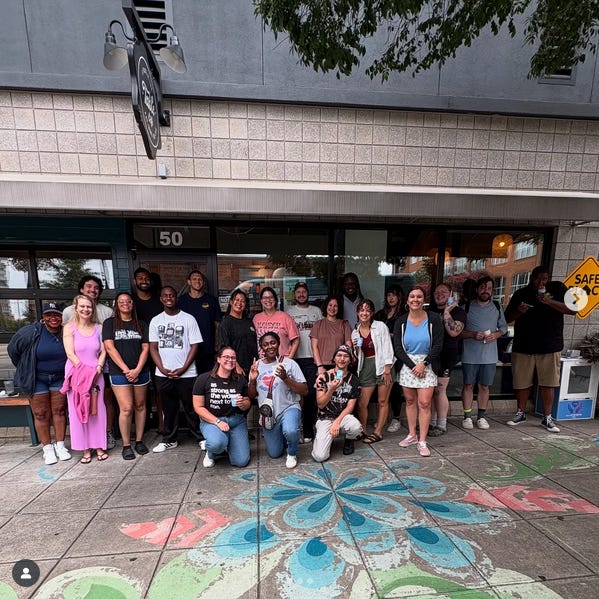
Because, of course, this isn’t just any restaurant. A Place at the Table is Raleigh’s first, and so far only, pay-what-you-can cafe. If you can make it to the Table, you will be fed.
The trappings are humble, peaceful, but quietly beautiful. My personal favorite spot is the “sunflower room,” where you’re surrounded on all sides by a hand-painted nature scene by local muralist J Massullo. Elsewhere, the walls are adorned with family-photo-style portraits of employees, volunteers, and members of the local community. Real flowers, courtesy of Flower Shuttle, sit pride-of-place at the center of each table. And as an added bonus, it’s right around the corner from RUMAH, at 300 W Hargett St #50.
In the interest of full disclosure, I ought to mention that my wife works at Table. Given my background (your average bog-standard upper-middle-class white dude), I might not ever have set foot in the place otherwise. But I’m glad I did. Spending time there finally opened my eyes to the very real gap in the social fabric that Table seeks to fill. Here, metropolitan workers and activists from downtown Raleigh rub elbows not just with each other, but with all sorts of people whom they might not otherwise spare a second glance. Table represents an opportunity - all too rare in the era of social media-driven isolation - to break out of your bubble and experience a real core sample of the city we all call home. Every visit, I’ll wind up in conversation with a total stranger. And by the end of that conversation, almost without exception, I will have made a friend.

A Place at the Table’s founder, Maggie Kane, came up in service fraternities and campus ministry organizations at NC State. When she caught a speech from activist Hugh Hollowell about a day shelter he was opening in downtown Raleigh, she knew she had to get involved. The shelter, known as Love Wins, provided a place for people experiencing homelessness and poverty to rest, relax, get a meal, and find community with each other. What really lit the fire under Maggie, though - and where you might have first heard her name - was an event locally known as Biscuitgate.
“Every Saturday and Sunday, our day shelter would organize groups that served biscuits and coffee in Moore Square Park, right in downtown. We’re out one Saturday... and the cops came over and said ‘you can’t serve here anymore.’”

To make a very long story short, the fallout from Biscuitgate prompted the City of Raleigh to found the Oak City Outreach Center, and ultimately Oak City Cares, a multi-purpose hub for people experiencing homelessness. Maggie put in time with both organizations, and through doing so, she found community through food.
Whenever Maggie had money to take her unhoused friends out to eat, they would always choose places like Golden Corral and K&W Cafeteria. She thought, at first, that her friends were choosing these places simply for the sheer volume of food they could put away while they were there. According to one of her friends, a man named John, she was only half-right.
“He said, ‘there are two reasons: one, I have choice. People in my daily life make every choice for me, and here I get to choose what I eat. Two, I feel seen. People treat me as a normal human here. I’m not invisible. People greet me, acknowledge me, come and check on me, they say goodbye as I’m leaving. I’ve got some dignity here.’”
Maggie also felt that, as a comparatively well-off person who spent so much time working and making friends with people experiencing extreme poverty, she walked in two worlds. How could she enjoin them? What kind of place could bring together people from all walks of life, in a shared environment centered around her friend John’s ideals of choice and dignity?
The answers to these questions would ultimately form the backbone of A Place at the Table. Maggie pulled in a restaurateur, a lawyer, a non-profit expert, and more, leveraging her privilege and her connections to form a team dedicated to bringing the idea of a pay-what-you-can business model into reality.
“I don’t know what I envisioned,” she admits. “But there’s a famous theologian, Frederick Buechner, who said ‘your vocation in life is where your greatest joy meets the world’s greatest need.’ My greatest joy is loving people, and one of the world’s greatest needs is hunger.”
Even seemingly small acts can have an outsized impact…if you have literally nothing else to offer, a little human connection goes a long, long way
The threat of poverty and homelessness is looming large for all sorts of people these days, thanks in no small part to our state and federal government’s failures to act on the housing crisis (not to mention a fair amount of outright sabotage in the form of budget cuts and public-private corruption). In this environment, it’s easy to find a cause worth championing. And yet, even though many of us wish to help our communities, it’s hard to know where to start. Plus, once we do get started, it can feel like we’re not making that big an impact. It’s easy to burn out.
Maggie stresses that “you don’t need to go out and start a non-profit, or a social enterprise or a movement. Do what you can. You can give time, or money, or just share (a post from an organization like ours) on Facebook - you may have a friend who needs to see it. Everyone can do something.”
Even seemingly small acts can have an outsized impact. “Just say hi,” she says, when you meet someone who’s struggling. Ask them where they’re from, how their day’s going. Get to know them. The ethos of A Place at the Table is an ethos you can take with you into your daily life. Make people feel welcome, wherever you go. Make them feel normal, visible, human. The concept of aid is not limited to tangible things - even if you have literally nothing else to offer, a little human connection goes a long, long way.
Volunteer opportunities at Table reflect this philosophy. You can help by washing dishes, running orders, bussing tables, rolling silverware, stamping bags, or greeting new customers at the door. No matter your level of experience or ability, if you want to pitch in, the folks at Table will find a place for you.

As for what Table needs right now, well, that’s a bit less esoteric.
“We want people to come eat here,” she says with a smile. “We want you filling the seats, filling the tables. Come as you are - maybe you pay, maybe you don’t. Either way, we’d love to have you.”
Here is where I want to personally encourage you to take her up on her offer. Because Table isn’t just a restaurant with a cool service-focused business model; it’s a great restaurant in its own right. The chicken and waffles is, in the words of famous TikTok restaurant reviewer Keith Lee, “seasoned really well, spicy from the hot honey. The waffle itself is sweet and fluffy... This is a really good meal.” As a breakfast man myself, I’ll second that review, and add that the breakfast burrito is one of the absolute best in town. And don’t pass on the pastries! Homemade Pop-Tarts, coffee cakes, cheesecake brownies, lemon poppyseed bread, gluten-free cookies... needless to say, I’m on a first-name basis with the baker there.
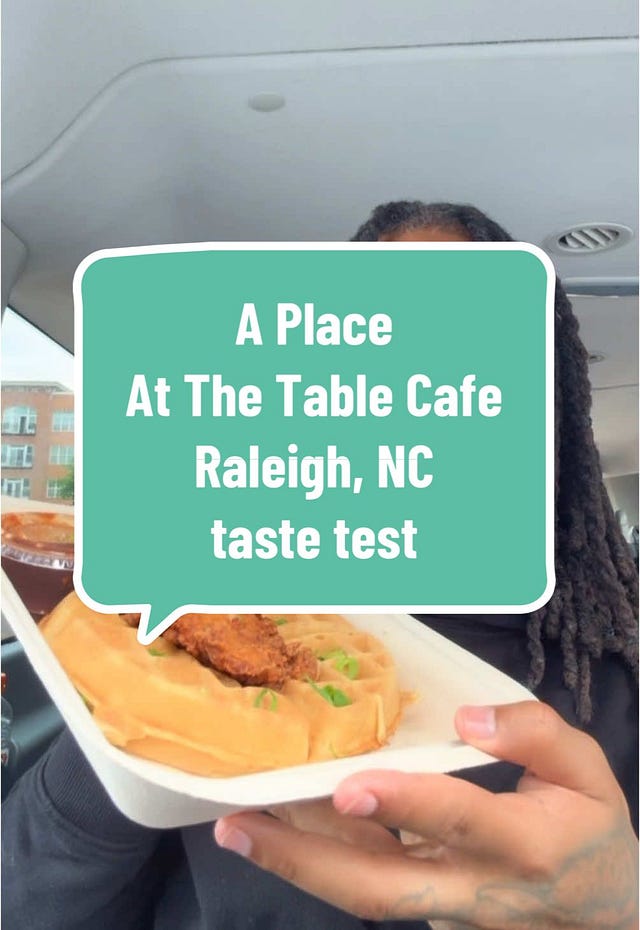
 Tiktok failed to load.
Enable 3rd party cookies or use another browser
But even if you can’t make it in-person, Maggie says, there are plenty of other ways you can show your support. You can always help raise awareness for Table’s mission through posting on social media, especially on city-level apps like Nextdoor and local subreddits. “Raleigh is always growing - what, 75 families a day? And these new people might not know we’re here. We want this to continue to be Raleigh’s community cafe, and the more people who know about us, the better.”
Triangle NC Resource Directory
RUMAH volunteers maintain the Triangle NC Resource Directory to help community members and organizations find and share information and resources. Organizations listed in this directory are not run by RUMAH, and must be reached out to directly: